
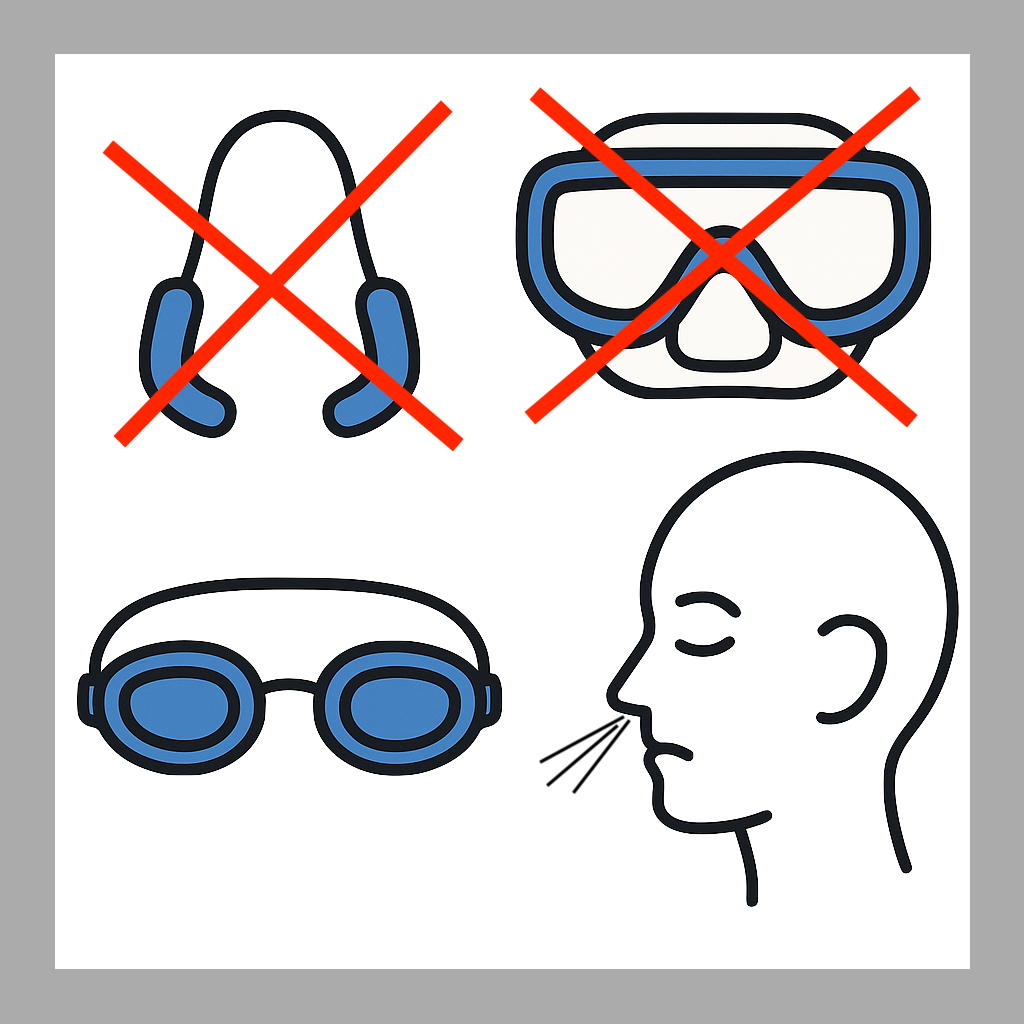
Many children learning to swim wear nose clips or full-face goggles that cover the nose. At first glance, these seem helpful — they prevent water from entering the nose, making submersion more comfortable. But are they really supporting learning? Or are they delaying a key part of water adaptation: learning to exhale through the nose?
Let me share the story of one of my students.
A Brave Step Forward — With a Simple Pair of Goggles
Today I worked with an 8-year-old beginner. She was afraid to put her nose in the water. It was clear this wasn’t just hesitation — most likely, a previous negative experience had left a lasting impression. There’s no time during a swim lesson to fully unpack a child’s past, but we can move forward gently, step by step.
During today’s session, for the first time, she dipped her nose into the water and managed to exhale slowly through it. She kept her eyes open and focused — reading the number I showed her with my fingers under the water. She was wearing standard goggles that left her nose uncovered. And it worked.
She was cautious, but in control.
When Equipment Becomes a Crutch
Later, we switched to a game: drop the rubber octopus toy deeper into the pool so it floats up in a zig-zag. The deeper the drop, the more fun. For this, she switched to her full-face goggles — the kind that cover the nose entirely. She held the mask tightly with one hand to prevent water from leaking in, while trying to release the toy with the other.
At one point, the mask shifted.
Water rushed in, and she surfaced coughing, panicked and struggling to catch her breath.
She knows how to exhale through her nose now. She can stay calm. But because the mask had taught her to ignore her nose — to rely on it being sealed — she didn’t use the new reflex. In that moment of surprise, she panicked. Her instinct was still to inhale through the nose.
And that’s exactly the problem.
Why This Matters
As long as a child wears a nose clip or a mask that covers the nose, they never have to learn the most basic aquatic reflex: only exhale through the nose underwater.
With a standard goggle, the child can only submerge as long as they can confidently exhale — and that’s a good thing. They remain connected to their body and breath. They build awareness, control, and trust.
But full-face masks remove that self-regulation.
They teach the child not to pay attention to their nose at all.
So what happens when they fall in the water unexpectedly — even just into the shallow end — and they’re not wearing the mask or nose clip?
Panic. Inhalation. And a very real risk of water being aspirated into the lungs.
My Advice
If your child is learning to swim:
- Start without a nose clip or nose-covering mask. Let them develop a natural breathing rhythm.
- Celebrate small steps. Just dipping the nose in and blowing bubbles is progress.
- Practice gently and regularly. Over time, the fear fades and the reflexes grow.
- Use goggles that leave the nose uncovered. So your child can build the ability to manage nose breathing on their own.
Swimming is not just about strokes — it’s about body awareness, breath control, and calm confidence. Let’s give children the chance to develop those skills, starting with the nose.