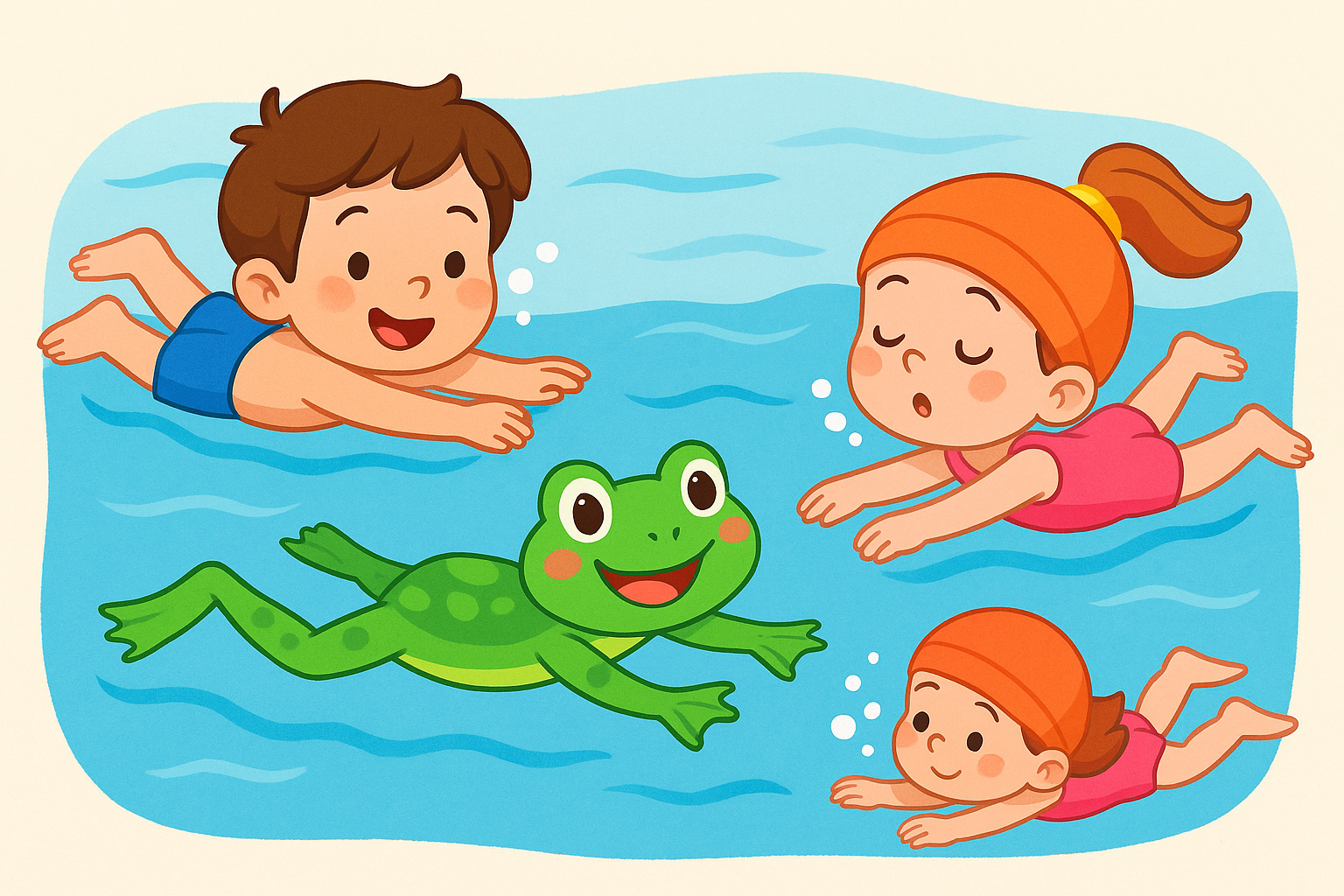
Verse 1 – Bug Heels to your bum, make yourself small, Curl up tight like a bug, that’s all! Knees together, round your back, This is the perfect swimming track!
Verse 2 – Frog Now open your legs, turn your toes out, Like a frog who’s ready to jump about. Wide and strong, but calm and slow, It’s not a race — just let it flow!
Verse 3 – Hopperman Here comes the kick — give it a go! Push the water with one strong throw. Just like Jumping Jack jumps so high, Kick with a pop and then you glide!
Verse 4 – Fish Now pull your feet back into line, Tight and neat — you’re doing fine! Like a fish with a pointed tail, Glide through the water, smooth and pale.
Verse 5 – Ballerina Keep your feet closed, point your toes, Like a ballerina who beautifully flows. Hold the line and glide so clean, You’re the smoothest the pool has seen!
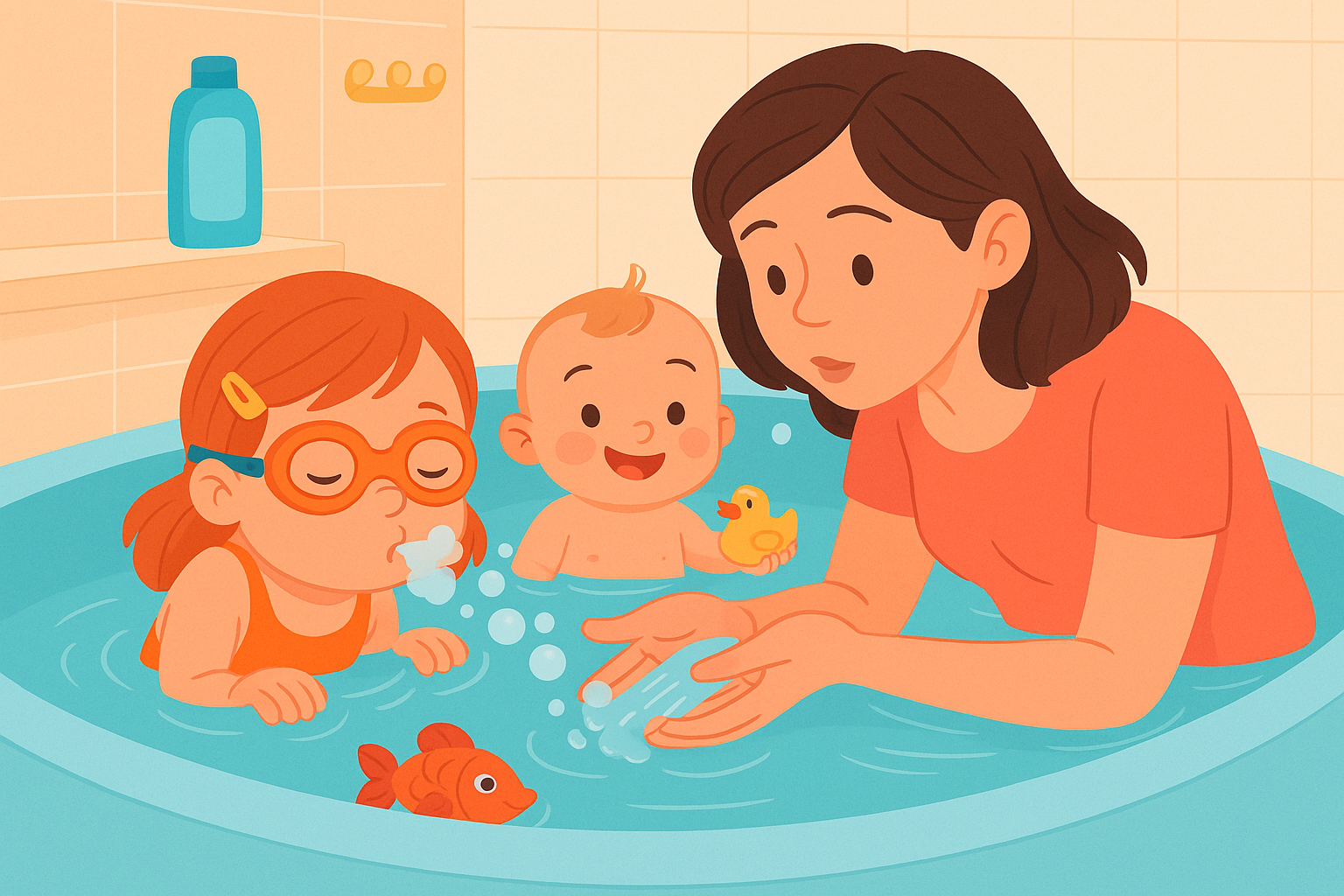
This guide is for parents, swimming teachers, and anyone who supports young children in learning to swim – especially those who want to help a child gently unlearn dog paddle arms during breaststroke.
If you’ve noticed that your child lifts their arms out of the water and paddles like a dog after breathing, this guide offers a playful, story-based way to help them develop smoother, more coordinated strokes – all without pressure or correction, and with lots of imagination instead.
Many young children, after taking a breath during breaststroke, instinctively switch to dog paddle arm movements. Instead of gliding their arms forward together underwater in a calm and coordinated way, they lift their elbows, paddle quickly at the surface, and disrupt their stroke rhythm.
This behavior often comes from anxiety, a lack of body awareness, or simply from copying others. It not only hinders progress in learning breaststroke but also leads to faster fatigue and less confidence in the water.
With a Tail
“Lily the Little Mermaid’s Adventure”
Imagine you’re Lily, a little mermaid who loves the water but is still learning how to swim like the graceful sea queens of the deep ocean…
One day, her wise sea teacher, Starry the Starfish, swam over and said:
“Dear Lily, if you want to reach the Magical Bubble Cave, you can’t splash like the tiny baby fish. The cave only opens for those who swim gently and gracefully – like the grown-up mermaids do!”
“Listen closely! Your hands should start together like two sleepy seashells, stretched out in front of you, as if you’re reaching out to hug a dolphin. Then, slowly open your arms wide, like drawing a big sunflower in the water, and bring them back to your chest – like this!”
“Don’t rush! The bubble cave only stays open if you swim calmly and slowly, because the magic bubbles are scared of splashes and will disappear.”
And guess what?
If Lily swims without doggy paddle splashing, using her quiet mermaid arms, she might see sparkling bubble stars under the water – they only appear for swimmers who move like the sea whispers.
With Games
1. Princess Arms Game
Imaginative role play:
“You’re a princess now, swimming gracefully underwater as if heading to an underwater ball. Your arms don’t splash around – they glide forward together and sweep out to the sides like a dance move.”
Tip: Practice in front of a mirror – palms together, stretch forward, then circle back slowly and symmetrically. Praise her at the end: “Just like a real mermaid!”
2. Turtle Challenge
Say to her:
“Now you’re a turtle! Turtle arms don’t flap around – they pull slowly and strongly underwater. If you splash too much, the turtle gets tired!”
Tip: Use a small turtle figure she can hold in her hands or balance on her head – it stays in place only if she stays calm and avoids flailing.
3. Bubble & Star Race
Goal: Only take a breath after completing one full, smooth arm movement.
Motto: “Bubble – Pull – Breathe – Star Arms!”
This gives her rhythm and breaks the reflex of switching to doggy paddle right after breathing.
Bonus: Underwater Baby Rescue Mission
Give her a waterproof doll or toy that she can “rescue” – but only if she swims to it with quiet, wide breaststroke arms. A peaceful approach makes the mission a success!
Welcome to your freestyle posture checkpoint — no pool required!
In this episode, we explore how a simple standing drill using a wall can awaken your body’s alignment, activate your core, and lay the foundation for a powerful freestyle stroke. You’ll learn how to feel your length from head to toe, stabilize your axis, and kickstart your stroke with full-body awareness.
Whether you’re a beginner building water confidence or an advanced swimmer refining technique, this posture-focused routine brings clarity to your movement patterns and prepares you to glide through the water with ease.
Let’s wake up your freestyle — one wall at a time.
Before you can move through water with ease, you need to find your anchor.
This 10-minute practice focuses on gently activating the deep core and pelvic floor – your inner stabilizers that support every stroke, every breath, every moment in and out of the pool.
Blending seated strength exercises, mindful breathwork, and grounding poses, this session helps you reconnect with your center – softly yet powerfully.
What you’ll practice:
Seated core activation and gentle bridges
Modified curl-ups for deep belly strength
Grounding breathwork and pelvic awareness
Ideal for:
Swimmers seeking better posture and inner control
Postpartum bodies in gentle regeneration
Anyone wanting to move with more presence, less tension
Feel how a strong center gives you freedom to glide.
Build from within – and let the water carry the rest.
Stiff shoulders after swimming? Neck tension from everyday stress?
This 10-minute session is your gentle rescue.
In this soothing, post-swim (or post-work) recovery flow, we melt tension from the neck and shoulders through mindful movement and breath. No equipment needed – just your presence, your breath, and a few calm moments to reset.
You’ll experience:
Neck and shoulder mobility drills
Gentle stretches to open the chest and side of the neck
Deep, tension-releasing breathwork
Perfect for:
Swimmers with tight upper bodies
Desk workers with rounded posture
New moms holding babies
Anyone carrying the weight of the day on their shoulders
Let go. Unwind. Float back into balance – one breath at a time.
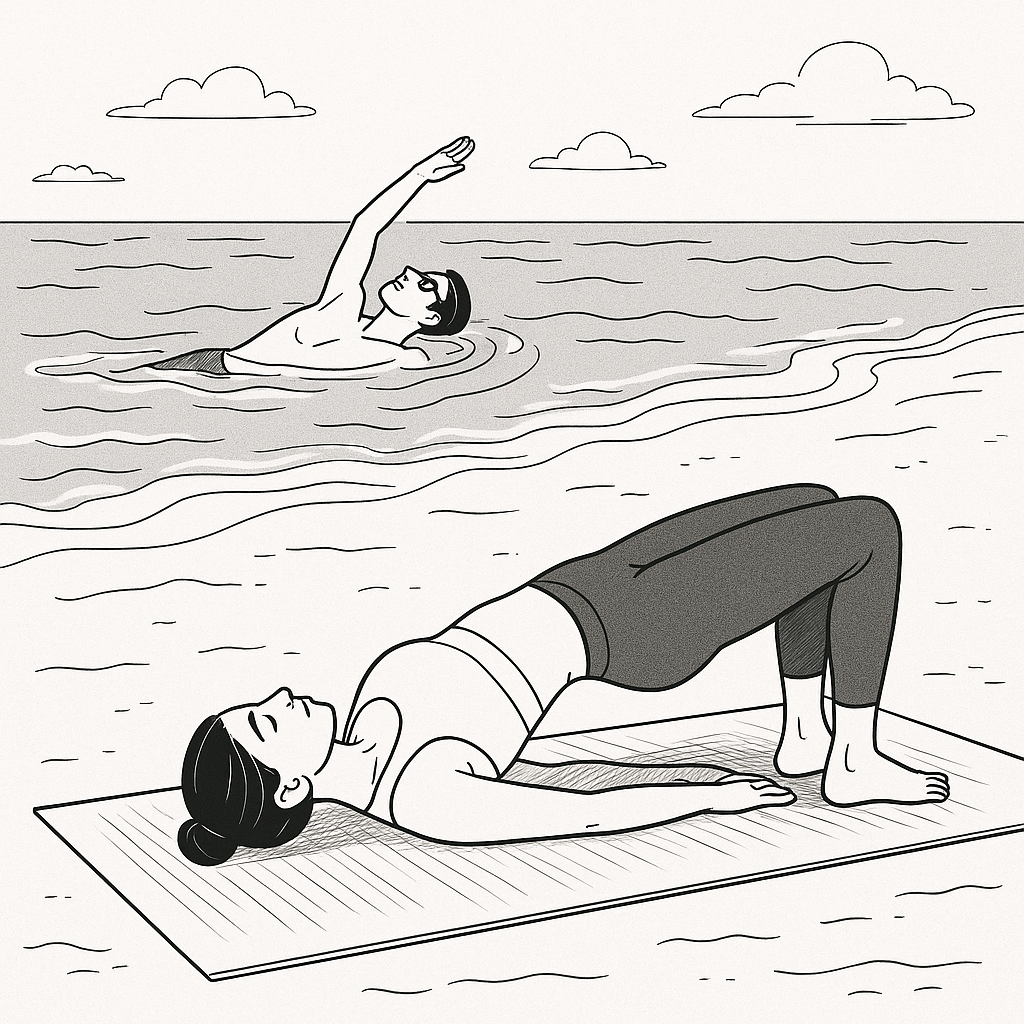
Dive into this shore-side practice designed to prep your body for the water — with a splash of inner strength and a ripple of awareness! Whether you’re a beginner swimmer or a seasoned mermaid, this session gently activates the muscles that matter most: shoulders, core, pelvic floor, and feet.
Through breath, mindful movement, and a sprinkle of imagination, you’ll explore how dryland training can make waves in your swimming technique. Think ballet toes, whispering abs, and shoulders that glide like dolphin fins.
No mudras, no mantras — just smart, subtle moves that help you float stronger and swim smoother.
From mat to water, it all starts here. Ready to feel the power of the pool… even before you dive in?
Tülay Aydın – A Warm, Interactive UX Presence That Inspires
As someone who reviews dozens of portfolios in the digital product space, it’s always refreshing to come across one that feels not only structured and strategic, but also genuine and human. That’s exactly the experience I had when exploring the portfolio of Tülay Aydın, Product Designer & Instructor. Whether you’re a UX design candidate, hiring manager, or mentor—Tülay’s approach offers several lessons worth sharing.
What I Loved About This Portfolio
The Colour Palette: Light and Warm
Screenshot
Tülay’s choice of color instantly stood out to me. The design feels inviting, approachable, and calming—a rare tone to achieve in UX portfolios, which often go too sterile or too playful. This balance helps her stand out while staying professional.
Subtle Motion = Interactive Feeling
I also loved the use of animated transitions and moving visuals. These aren’t just decorative—they give the site a dynamic, “alive” feeling, which echoes her mindset as a designer who understands engagement and user feedback loops.
Case Study Depth
Screenshot
The case study I read (FanMeet) was rich in process details, showing her ability to handle both UX research and UI design, while also thinking about community impact. It’s clear that she goes beyond surface-level visuals and dives into structure, iteration, and meaningful storytelling.
Instructor & Mentor Identity
Screenshot
It’s also fantastic to see how Tülay merges her work as a mentor and curriculum designer into her UX story. That level of reflection, pedagogy, and knowledge-sharing is not just admirable—it’s exactly what many senior design teams need.
A Few Ideas for Improvement
No portfolio is ever “done” (and that’s part of the beauty!). Here are a few gentle suggestions that could make Tülay’s portfolio even stronger:
Include results or metrics in case studies: A few numbers or user testing quotes would strengthen the sense of impact.
Visual storytelling: Wireframes, flows, or mockups could add more visual depth to the process stages.
Consider using a clear case study structure, like:
The Problem
The Process
The Solution
The Impact
Final Thought
Tülay’s portfolio is a great example of how to combine professional UX maturity with personality and warmth. Her work not only communicates what she does, but how she does it—with care, curiosity, and clarity. If you’re hiring a product designer, looking for a mentor, or simply want inspiration for your own portfolio journey—Tülay’s approach is well worth exploring.
Explore Tülay Aydın’s Portfolio
To see Tülay Aydın’s impressive work and the thoughtful design elements mentioned in the feedback, visit her portfolio at tulaydin.com. Exploring her website will give you a firsthand experience of her approach to UX design, showcasing her skills, case studies, and overall aesthetic.
Hi! I’m Reed, and I’m almost six years old. I’m in theBunny class, and my symbol is a car because I really love vehicles. Today we’re finally going on a bus ride with nursery school – it’ll be my first real bus trip! Daddy always drives me to nursery, but today we’re going with Mrs Johnson and the others. I can’t wait to see how the bus driver drives!
This morning, I woke up before Mummy even came to wake me. I’m so excited. Today Mrs Johnson and Ms Wright are taking us on a bus ride. I’ve never been on a bus before. Daddy drives me every morning on his way to work.
I picked out my bus t-shirt and car jeans last night. By the time Mummy comes in, I’m already dressed and ready to go. Even Daddy is surprised that he doesn’t have to wait for me.
The car is moving quite slowly today. Usually our BMW zooms like the wind.
“Don’t worry, we won’t be late,” Daddy says reassuringly. “Look at that cyclist weaving between the cars!” “He must be in a hurry, maybe trying to catch his bus.” “Probably,” Daddy chuckles as we turn into Nursery Street.
I don’t want to take off my shoes since we’ll be leaving soon, but Daddy says we can’t go into the class room with outdoor shoes.
“Alright then, off you go. Bye, Daddy!” “Bye, Reed,” Daddy hugs me as I head toward the classroom.
Good thing I’m not the last to arrive. A few children are already sitting on the carpet, listening to Ms Wright.
“Who comes to nursery by car?” Ms Wright asks. We always raise our hands if the answer is yes. I raise mine as I sit down. Lots of hands are up.
“And who comes by bus?” she asks again. Only Clara raises her hand. Her grandmother doesn’t drive, so they don’t have a car.
“And those who didn’t raise your hands at all – how do you get to nursery?” “We usually walk,” say the twins, Blossom and Blake. “I come on my go-kart,” answers George. “And Mummy always runs after me!” he giggles. Then it goes quiet.
Ms Wright stands up and starts walking in circles, singing. Then she raises her hand and continues the song while opening and closing her arms. Soon everyone is up dancing and jumping. We learn the song and hop along while we sing:
The wheels on the bus go round and round, Round and round, round and round,
The wheels on the bus go round and round, All through the town.
The doors on the bus go open and close, Open and close, open and close,
The doors on the bus go open and close,All through the town.
How would you colour this picture? You can find it in the Downloads.
Then send it to us so others can see your wonderful creation too!
Mrs Johnson comes into the room. I run to her:
“Do you know where we’re going today?” I ask. “Nooo, where?” Mrs Johnson replies with a grin. “We’re going on a bus ride!” “Just a bus ride? With no destination?” she asks incredulously. “I don’t know,” I turn to Ms Wright. “Well then, it’s time to plan our route,” says Ms Wright and starts drawing something. “Who recognises this?”
There’s silence for a moment. “Those are apples!” shouts Daisy. “And there are carrots!” adds Charlotte. “Exactly. So what could this place be?” asks Mrs Johnson. “A shop,” guesses George. “A market,” whispers Clara.
“Yes, we can buy fruit and vegetables at a shop or a market. Who has been to a market before?” Only a few hands go up.
“Brilliant! There’s a market a few stops from here. That’s where we’ll go. Let’s make a map!” Mrs Johnson takes out building blocks. “This is the nursery. Where’s the bus stop?”
We mark the nursery with children and a teacher. We even place the gardener figure, though he’s not coming with us.
“Bring over the dominoes, the Duplo basket, and the train set. We’ll make a bus stop where we need to get on.”
There’s a train station at the stop where we’ll get off.
On the way to the market, we’ll walk past a petting zoo.
Now the map is complete and everyone knows the route.
“Let’s build the bus too!” calls Ms Wright.
We line up chairs next to each other. One chair in front for the driver, then rows of two with space between them to walk.
“Alright, everyone queue up at the front door. That’s where we’ll board. Reed, please open the door,” says Ms Wright. She and Mrs Johnson explain in detail what’s going to happen and what we need to do.
“Can I be the driver?” I ask, bouncing. “Of course. Go take your seat,” says Mrs Johnson. “What happens when the bus arrives at the stop?” “It opens the door!” replies Stuart.
We pretend to go on the bus ride several times. George, Stuart, and Daisy also get a turn as the driver when I’m a passenger.
After the game, we tidy up the chairs because it’s time for snack. They bring out fruit and vegetables.
After eating, the big moment finally comes. Everyone has to use the toilet before we go. We get dressed and head to the bus stop. George is usually my partner, and we’re at the front. But today Ms Wright asks every big kid to choose a little one as a partner. I choose Kendall.
“Will I be able to climb the steps?” asks Arthur. “What if the doors close on me?” worries Hannah. I hope I’ll get a seat because I’m afraid I won’t reach the handrail.
We don’t have to wait long. The bus arrives. Ms Wright gets on first and punches a ticket. Then we all start boarding. The bus is almost empty, so I quickly grab the front seat to see the driver and the road. Mrs Johnson gets on last. She doesn’t validate a ticket.
“Mrs Johnson! Why didn’t you punch a ticket?” I ask. “I have a pass. I just have to show it when I get on.” “Do we need passes too?” Kendall asks beside me. “Not yet, only when you go to school.” “And why doesn’t Ms Wright have a pass?” asks Daisy. “I live near the preschool, so I usually ride my bike. When I rarely take the bus, I always punch a ticket.”
“Look here!” she says. “These are the rules for riding the bus. What do you think this one means?” She points to a picture of a hamburger and a drink.
“You have to swallow your food before getting on the bus,” Willow chimes in. “That’s right, doing anything with your mouth full can be dangerous,” adds Ms Wright with a smile. “You’re not allowed to eat,” says Clara. “No drinking,” adds Edison.
The other children chime in. They show signs for no smoking, no glass bottles, no littering. But one sign no one knows. The bus goes quiet.
“Any ideas?” Mrs Johnson asks Ms Wright. “No clue,” says Ms Wright, scratching her head. “I’ll take a picture on my phone and check it online at home. If you ask me tomorrow, I’ll tell you what I found out,” Mrs Johnson decides. “There are also permission signs, not just prohibition ones.”
“What could the first sign be?” Mrs Johnson asks again. We don’t know. Then Ms Wright holds up the ticket she punched when boarding.
“You have to have a ticket,” shouts Edison. “Exactly,” agrees Ms Wright. “Now let’s signal – our stop is next. When you stand up, look back and check your seat and the area around it to make sure you didn’t leave anything behind.”
“Who knows the way back to nursery from this stop?” asks Mrs Johnson once we’ve all gotten off.
A few hands go up.
“Alright, Gladwin, lead the way and the others, pay attention to the route.”
When we get back to nursery, it’s already lunchtime. We’re all tired after the bus ride and the market.
At nap time, Mrs Johnson tells the story of Buci the Bus’s day.
Even at night, the streets never truly slept. There was always traffic, even at this hour. Buci bus rolled out of the terminal and began his route.
How would you colour this picture? You can find it in the Downloads.
Then send it to us so others can see your wonderful creation too!
Mummy comes to pick me up early today, even though I would’ve loved to play more bus games. I run to her:
“Mummy, Mummy, guess what – we went on a bus, and I saw how the driver drives! We almost hit a dog. And there was a rule nobody knew, not even the teachers. It had weird lines on it.”
“Well, that’s why you mustn’t go speeding on the bus either. I don’t know what that sign means, but come on, get dressed quickly, we’re in a rush. You can ask Daddy.”
Mummy never lets me sit in the front of the car, so I can’t see how she drives. But there are so many signs on the road. What could they mean?
I’m getting ready for my bath when Daddy comes home.
“Daddy, do you know what signs there are on buses?” I ask on the way to the bathroom. “No, what kind?” Daddy replies, tired. “No eating, no drinking, no ice cream. But you can take a bike or a dog – dogs need a muzzle. But there was one sign no one could figure out. It had loads of lines.”
“Hmm, that’s interesting.” “Right?! I really want to know.”
“Alright then, let’s look it up.” Daddy sits down with the laptop and I climb onto his lap.
He types for a while until lots of pictures pop up on the screen.
“Let’s see… This one says ‘TAG’. It means to keep the bus clean and not to draw on it. Now off you go to the bath.”
“Is the one I was looking for there?” “There’s one that says don’t wear your backpack on your back. Do you know why you have to take it off?”
“I guess so you don’t bump into other people.”
“Ah, I see. Wait, go back. Yes – that’s the one!”
After Reading
How many bunnies did you find hiding in the pictures? Here’s a hint: each one has at least one!
Your City (Mrs Johnson’s questions)
Comprehension and Memory (George’s questions)
Emotions and Social Skills (Stuart’s questions)
Problem Solving and Creativity (Clara’s questions)
Lessons and Values (Daisy’s questions)
Imagination and Play (Kendall’s questions)
Empathy and Relationships (Newton’s questions)
Adventure and Exploration (Blossom’s questions)
Logical and Language Skills (Blake’s questions)
Environment and Awareness (Charlotte’s questions)
Fantasy and Reality (Hannah’s questions)
Experiencing the Story (Reed’s questions, tasks)
Szómagyarázat
Találós kérdések
Pedagogical Reflection
Theme and Objectives
Theme: The central theme of the story is the experience of taking the bus and learning the associated rules and social norms.
Objectives:
Transport Awareness: Children become familiar with the rules of riding a bus and related behaviours.
Social Development: Collaborating in a group and sharing experiences strengthen social skills.
Independence: Children learn about independent travel and following social rules.
Physical and Emotional Safety
Safety: The adults in the story pay attention to the children’s physical safety (e.g., removing outdoor shoes, rules at the bus stop).
Emotional Safety: The supportive behaviour of the adults, their clear answers, and the open space for questions all contribute to a sense of emotional security.
Social Skills
Cooperation: The children work together to build a map and create a pretend bus, which strengthens cooperative skills.
Communication: Through active participation in conversations, questions, and answers, children develop their communication abilities.
Cognitive Development
Problem Solving: Planning the route and building the map helps develop logical thinking and problem-solving skills.
Knowledge Expansion: Learning about public transport and visiting a market expands the children’s understanding of daily life and travel.
Creative Development
Singing and Dancing: Singing and dancing to “The Wheels on the Bus” supports rhythm and movement coordination.
Play-Based Learning: Role-playing the bus ride and creating the route map are playful ways to engage children in learning.
Language Development
Vocabulary Building: The story and related discussions introduce new words and expressions.
Speech Development: Telling the story and interpreting bus symbols support the development of expressive language.
Learning Rules and Norms
Traffic Rules: The story introduces basic bus travel rules and the importance of tickets or passes.
Social Norms: The narrative models behaviours such as queuing, signalling, and respectful communication.
Conclusion
The story “Monday – Reed and the Bus” offers numerous pedagogical benefits for preschool-aged children. It not only introduces traffic rules and the excitement of riding a bus, but also fosters social, cognitive, and language development. Through interactive and playful experiences, children are taught important social norms and the fundamentals of safe travel, all while encouraging independence and cooperation within the group.
Activity: The Bus Game
The bus game organised by the preschool teachers offers numerous educational and developmental benefits. Here are some key reasons why this game is especially valuable for preschool-aged children:
1. Development of Social Skills
The bus game gives children the chance to collaborate and communicate with one another. Through shared activities, they learn to queue, wait patiently, cooperate, and pay attention to each other. This strengthens their sense of community and enhances their social skills.
2. Rule-Following and Discipline
Children learn to follow rules through the game—for example, the order of getting on and off the bus, how to behave safely during the ride, and the use of tickets. These experiences help them understand the importance of discipline and public transport rules.
3. Creativity and Imagination
Building a bus from chairs and designing a route map stimulate children’s creativity and imagination. It helps develop their problem-solving abilities and creative thinking.
4. Knowledge Building and Learning
While playing, children learn how public transport works, how bus journeys unfold, and what traffic rules are involved. These practical insights are useful in their everyday lives and build foundational knowledge.
5. Motor Skills Development
The physical elements of the game—boarding, exiting, sitting in order—help children develop fine motor skills and body coordination.
6. Confidence and Independence
Roleplay activities like this allow children to take on different roles—driver, passenger, ticket inspector—which boosts their self-confidence and fosters independence as they try out real-life scenarios in a safe space.
Conclusion
The bus game is an excellent educational tool that develops a wide range of skills and abilities in preschoolers. Through playful learning, group experiences, creativity, and the transmission of practical knowledge, children gain a deeper understanding of how the world works. And best of all—it’s fun! This kind of activity supports their growth in an engaging and enjoyable way.
Psychologist’s Perspective
1. Emotional Development
Excitement and Anticipation: Reed’s excitement about the upcoming bus trip is a natural emotional response to a new and unknown experience. This excitement fuels his curiosity, which is fundamental for learning and development.
Reassurance and Security: His father’s calming words and the structured routines (e.g., taking off his outdoor shoes) provide Reed with emotional security. The presence and support of the teachers—Mrs Johnson and Ms Wright—further reinforce a sense of safety and stability for the children.
2. Social Development
Group Activities: Joint activities like singing, dancing, planning the map, and pretending to take a bus trip help children learn how to work together toward a common goal. These experiences promote group cohesion and improve social skills.
Empathy and Compassion: Through communication and cooperation, children practise empathy and compassion. For example, when Reed chooses Kendall as his partner, it shows that he is attentive and caring toward his peers.
3. Cognitive Development
Problem-Solving: Creating a map and planning a route present cognitive challenges that enhance problem-solving abilities and spatial awareness.
Learning Motivation: Reed’s curiosity and eagerness to learn something new reflect strong intrinsic motivation. Learning about traffic rules and how buses work expands his knowledge and helps him better understand the world.
4. Language Development
Communication Skills: The dialogues and questions in the story give children opportunities to practise language, expand their vocabulary, and improve their communication skills.
Asking and Answering Questions: Encouraging children to ask questions and seek answers supports critical thinking and self-expression.
5. Understanding Rules and Norms
Traffic Rules: Learning the rules of bus travel and recognising symbols on public transport helps children understand the norms of shared public spaces.
Behavioural Norms: Group activities and adult guidance teach children important social norms such as queuing, using tickets, and paying attention to others.
6. Independence and Self-Confidence
Developing Independence: Reed gets ready on his own, chooses his clothes, and eagerly anticipates the adventure. This level of independence supports the development of self-confidence and autonomy.
Positive Feedback: Supportive and encouraging feedback from adults (parents and teachers) strengthens children’s self-esteem and self-worth.
Conclusion
From a psychological perspective, “Monday – Reed and the Bus” offers numerous benefits for preschool children. Emotional security, social development, and the support of cognitive and language growth all contribute to a well-rounded developmental experience. The story teaches children traffic rules and social norms in a playful way, while also fostering independence and confidence. Experiences like this enrich children’s daily lives and prepare them for future challenges.
Parent’s Perspective
Positives
1. Emotional Reactions and Excitement
The story beautifully captures a child’s excitement and curiosity when faced with a new experience. Reed’s enthusiasm about the bus trip and his early wake-up time reflect genuine eagerness. This emotional energy helps children stay motivated and open to new experiences.
2. Learning and Traffic Rules
The story shows how children learn about traffic rules and using public transport. This is very beneficial, as children are introduced to the basics of public transportation and road safety at an early age. The fact that it’s done in a playful, engaging way makes the learning more understandable and memorable.
3. Social and Communication Skills
Group activities such as singing and map-making support the development of social skills. Children learn to collaborate, communicate, and pay attention to one another—skills that are essential for their social development during the preschool years.
4. Independence and Confidence
Reed’s independence in preparing for the day serves as a positive example. This autonomy builds self-confidence and nurtures a sense of responsibility, both of which are crucial for children’s growth.
5. Empathy and Support
The story highlights how children and teachers support one another. For example, when Reed chooses Kendall as his partner, it shows empathy and attentiveness. This kind of caring behaviour is key to developing emotional intelligence and strong peer relationships.
Areas for Improvement
1. Unclear Information
The story includes an unknown sign on the bus that remains unresolved for most of the day. While the adults plan to research it later, it would be helpful if the story offered a clearer or quicker explanation to avoid lingering uncertainty for young readers.
2. More Safety Education
Although the story introduces traffic rules, it could benefit from more detail about safe behaviour—like how to wait at a bus stop or how to board and exit the bus safely.
3. Parental Involvement
The role of the parents is quite limited in the story. It would be valuable to include more interactions between parents and children, showing how parents can support their kids in processing new experiences and becoming active participants in learning.
Conclusion
As a parent, I find this story very positive. It captures the excitement and curiosity children feel and delivers important messages about traffic safety and social skills. The story helps children become more independent and confident while teaching them how to cooperate and care for one another. Though there are some areas that could use additional detail or clarification, overall, it is a very helpful and enriching read for preschool-aged children.
Tale
A Day in the Life of Buci Bus
Even at night, the streets never truly slept. There was always traffic, even at this hour. Buci bus rolled out of the terminal and began his route.
It was dark, the moon lit up the sky, and the streetlamps shone below. He moved along precisely, right on schedule. He started at the green light and stopped at the red. He paused at every stop. Some passengers got off, others climbed aboard, then the doors closed again. Buci bus rolled on. Young people chatted cheerfully, sitting in their seats. Most of them were out having fun, laughing and giggling. Buci bus listened in, curious and cheerful.
Suddenly, a red car cut in front of him. Buci bus hit the brakes with all his might. His wheels even screeched.
“Whoa, whoa, whoa!” everyone screamed.
Passengers who were standing nearly fell over. Even those sitting gave a little jolt. Many started grumbling. Buci bus wiped his brow.
“That was a close one. Could have ended badly. Good thing I was watching everything,” he muttered to himself. “Let’s keep going.”
Just then, the light turned red. Buci bus stopped.
“I saw what happened,” said the red light sternly. “It’s really upsetting how careless that driver was. And if there had been an accident, he would’ve acted like the victim.”
“Luckily nothing happened,” said Buci bus with a smile, already moving on from the scare.
Meanwhile, the sky began to lighten. Dawn broke, then morning arrived. Buci bus continued on his scheduled route. He passed by a row of tall, slim trees.
“They smell so nice!” Buci thought.
He took big, happy breaths of the morning air. Passengers came and went. Schoolchildren and preschoolers boarded, most with their mums or dads. Buci bus smiled, listening to their cheerful chatter. At the next stop, they got off too. Just as he was about to continue, a shaggy dog darted in front of his wheels. Its owner ran after it:
“Stop, Shaggy!” But the dog kept running.
Buci bus braked hard again. His wheels screeched.
“Whoa, whoa, whoa!” people shouted.
Those standing nearly toppled, and even the seated bounced in their seats. People grumbled once more. Buci bus wiped his brow again.
“Another close one. Could have been bad. Good thing I was paying attention,” he muttered, once the danger had passed.
By now, mostly older passengers were on board. They climbed the steps slowly, leaning on walking sticks. Two young schoolchildren jumped up politely to help.
“Thank you so much!” the elderly passengers said with teary eyes.
Some were off to the doctor, others, with shopping bags in hand, headed to the market for fresh produce. The whole morning passed like this.
At noon, it was time for lunch break. Buci bus had his meal. While he refuelled with diesel, he rested. He watched the clouds drifting across the sky and felt the gentle sun on his back. It made him smile—it felt so nice. He watched little birds fly into the trees.
“Oh, how sweetly you sing! You’re so tiny, so teeny-tiny!” he said to them.
“Thank you! Tweet-tweet, tweet-tweet!” they chirped in reply.
In the afternoon, Buci bus set off again. He went straight, then turned right, then left. Right on schedule. He started at the green light and stopped at the red. At each stop, people got on and off, the doors closed, and Buci bus moved on. A green light gave him the go-ahead.
But then, someone dashed across the zebra crossing in front of him, even though the pedestrian light was red. Buci bus slammed on the brakes again. His wheels screeched.
“Whoa, whoa, whoa!” came the cries. Those standing nearly toppled; those sitting bounced.
Grumbling filled the air. Buci bus wiped his brow.
“Yet another careless person. If there had been an accident, they would’ve blamed me! Almost happened… almost…” he thought. “Good thing I kept my eyes everywhere.” He noticed the pedestrian clutching their chest, clearly startled. But instead of stopping, they rushed across the road as if nothing had happened.
“I bet the traffic police would’ve fined them if they had seen that. One day, they’ll learn the hard way… ‘The jug goes to the well until it breaks,’ as they say.”
But Buci bus carried on—he had a timetable to keep. His bad mood faded, and he started humming to himself.
La, la, la, la…
Brr-brr, brr-brr, goes the motor,
Look at that driver—couldn’t be bolder!
Over the cobblestones, rattling away,
My exhaust goes puff-puff all day!
Clever guy, texting away,
In this traffic jam? No way!
We inch along like a hungry caterpillar—
Will we make it home, my dear sister?
La, la, la, la…
Eventually, night fell. Buci bus returned to the garage, tired and ready for rest.
“What a day! Full of excitement but beautiful too,” he thought—and closed his eyes, drifting into a sweet sleep.
Poem, Nursery Rhyme, Song
I am a bus
I am big and long
I carry many people
I stop at bus stops
I drive in the city
The wheels on the bus go round and round
The wheels on the bus go ’round and ’round ‘Round and ’round, ’round and ’round The wheels on the bus go ’round and ’round All through the town
The doors on the bus go open and shut Open and shut, open and shut The doors on the bus go open and shut All through the town
The wipers on the bus go swish, swish, swish Swish, swish, swish, swish, swish, swish The wipers on the bus go swish, swish, swish All through the town
The signals on the bus go blink, blink, blink Blink, blink, blink, blink, blink, blink The signals on the bus go blink, blink, blink All through the town
The horn on the bus goes beep, beep, beep Beep, beep, beep, beep, beep, beep The horn on the bus goes beep, beep, beep All through the town
The motor on the bus goes vroom, vroom, vroom Vroom, vroom, vroom, vroom, vroom, vroom The motor on the bus goes vroom, vroom, vroom All through the town
The people on the bus go up and down Up and down, up and down The people on the bus go up and down All through the town
The babies on the bus go, „Wah, wah, wah” „Wah, wah, wah, wah, wah, wah” The babies on the bus go, „Wah, wah, wah” All through the town
The mommies on the bus go, „Shh, shh, shh” „Shh, shh, shh, shh, shh, shh” The mommies on the bus go, „Shh, shh, shh” All through the town
The daddies on the bus go, „I love you” „I love you, I love you” The daddies on the bus go, „I love you” All through the town
The wheels on the bus go ’round and ’round ‘Round and ’round, ’round and ’round The wheels on the bus go ’round and ’round All through the town
Game
🚌 Bus Construction from Chairs (Bus Role-Play)
Type of Activity: Role-play
Developmental Areas: Social behaviour, rule awareness, recognition of social roles
Why is it great? Children get to act out a piece of the adult world. By becoming bus drivers, passengers, or ticket inspectors, they enjoy the fun of role-playing while practising polite and rule-following behaviour. Arranging the chairs also supports spatial orientation and awareness.
📍 Map-Making with Building Blocks (Route to the Market)
Why is it great? Creating a map encourages children to represent real-life experiences through abstract thinking. Designing a route based on their own adventures supports narrative thinking (beginning–middle–end) and helps them process personal experiences.
🗣️ Discussion and Q&A about Means of Transport
Type of Activity: Verbal, reflective discussion
Developmental Areas: Language development, self-expression, attention
Why is it great? Children share their own experiences while listening to others, which helps improve their vocabulary and speaking skills. It also nurtures attention, turn-taking, and empathy.
🎶 “The Wheels on the Bus” – Song with Movement
Type of Activity: Singing and movement-based game
Developmental Areas: Coordination, rhythm, body awareness
Why is it great? Following the movements supports gross motor development, while repeating the lyrics strengthens memory and musical sensitivity. Movement-based songs also help release tension and regulate energy.
🚦 Recognising Traffic Rules on the Bus (Signs & Symbols)
Why is it great? Noticing and interpreting real-life rules provides cognitive challenges while teaching children—through play—how to behave in everyday transport situations. It also helps them understand the importance of safety and shared responsibility in traffic.
The different ways of expressing “making money” across languages reveal much about cultural attitudes toward finance, with deep historical, psychological, and ethical dimensions. These expressions don’t just influence personal well-being and social stability — they shape national economic strategies as well.
The Verbs Behind “Making Money”
Each culture chooses distinct verbs to express the concept of earning money, reflecting their historical evolution, economic structures, and societal values. For instance:
Germanic languages (e.g., German, Dutch, Luxembourgish) typically use words meaning “to deserve” or “to earn,” emphasizing merit and hard work. The English earn and German verdienen suggest that in these cultures, money is closely linked to diligence and individual effort.
Romance languages (e.g., French gagner, Spanish ganar) use terms associated with “winning” or “gaining,” reflecting a more opportunistic view, where making money is seen as a competition or a chance-based pursuit.
Scandinavian languages (e.g., Swedish tjäna, Norwegian tjene, Danish tjene) use verbs meaning “to serve,” highlighting the communal role and social contribution as central to the value of work. Money here is not just a personal goal, but a measure of one’s benefit to society.
Slavic and Uralic languages (e.g., Hungarian keresni, Polish. zarabiać, Russian зарабатывать, Finnish ansaita) often use verbs equivalent to “search”, portraying money-making as a continuous, effortful process — something elusive that requires ongoing striving.
Asian languages like Mandarin or Korean connect making money to verbs meaning “to do” or “to create,” emphasizing action, productivity, and stability through family and self-realisation. In these cultures, money is seen more as a tool for activity and than a matter of luck or merit.
National Case Studies: The Impact of Financial Mindsets
The Puritan Work Ethic in the United States
The Puritan settlers who arrived in 17th-century America valued deserving and serving, principles that laid the groundwork for the U.S.’s economic ascent. According to Max Weber’s theory of the Protestant work ethic, the culture of saving and reinvestment contributed significantly to the development of capitalism.
Spain’s Decline: The Pitfall of “Winning” Wealth
In the 16th–17th centuries, Spain amassed enormous wealth from New World gold and silver. However, this “easily won” prosperity led to excessive spending and long-term instability. The decline suggests that a money mindset rooted in luck or conquest can leave an economy vulnerable — especially when innovation and industrial growth are neglected.
Japan’s Economic Miracle: Building on Creation and Savings
In the second half of the 20th century, Japan’s culture of saving and hard work fueled rapid economic growth. High individual savings and corporate loyalty enabled domestic investments that powered industrial development. Japan’s success reflects the “doing” and “acquiring” attitude.
China: Pragmatism in a Socialist Market Economy
Confucian values once emphasized balance and moderation, but modern China’s pragmatic approach — the so-called “socialist market economy” — has merged diligence, central planning, and reforms to foster massive growth. The shift toward “doing” and “acquiring” is now central to China’s global economic rise.
Germany: Economic Discipline Rooted in Merit
Post-WWII Germany’s verdienen and thrift-based approach contributed to the Wirtschaftswunder (economic miracle). With an emphasis on earned success, savings, and long-term planning, Germany became not just a financial powerhouse but also a model of responsible financial thinking.
The Arab World: Ethical Acquisition Through kasb
In Arabic, kasb expresses money-making with the idea of “acquiring” or “gathering,” deeply connected to Islamic ethics. With concepts like the prohibition of interest (riba) and mandatory charity (zakat), kasb reflects not personal gain but communal responsibility.
Switzerland: Multilingualism and Financial Attitudes
Switzerland’s various linguistic regions each use different verbs for “making money,” revealing how cultural-linguistic differences influence financial behavior.
German-speaking regions (e.g., Zurich, Basel, Bern) use verdienen, reinforcing strict financial discipline and a culture of hard work.
French-speaking regions (e.g., Geneva, Vaud) use gagner, suggesting openness to opportunity and business flexibility. Geneva’s global banking prominence reflects this attitude — its relaxed regulatory environment welcomes innovation and international clientele.
Italian-speaking regions (e.g., Ticino, Lugano) use guadagnare (“to acquire”), creating an environment attractive to Southern European clients seeking adaptable, flexible banking structures, although economic weight remains smaller than in Zurich or Geneva.
Romansh-speaking regions (e.g., Graubünden) use vulair, meaning “to acquire” or “achieve,” representing a pragmatic, nature-oriented lifestyle. Economic activity here is more localized and stable but modest in scale.
Switzerland’s financial flexibility and global success are partly thanks to this multilingual, multifaceted approach to money — blending the prudence of verdienen, the innovation of gagner, and the adaptability of guadagnare.
The “Pessimistic Search” Mentality
In countries where the verb „to search” is used — such as Hungary, Russia, Poland, Finland — the money-making process is viewed as continuous and elusive. This mindset often correlates with economic instability, short-term strategies, and reduced innovation.
People may feel that financial success is uncertain and must be chased endlessly, leading to stress, risk-aversion, and low motivation for long-term investments. This also affects productivity and economic morale — workers may merely “get the job done” without aiming for personal or professional development.
Is Positive Change Possible?
Yes. Estonia offers a successful example of shifting from a “searching” mentality to a proactive, confident financial attitude by investing in digital infrastructure, financial education, and entrepreneurship.
Estonia’s Transformation
In Estonian, raha teenima (“to earn money”) includes the verb teenima, meaning “to search” or “to work for.” After independence from the Soviet Union, Estonia faced economic hardship. The government implemented:
E-government & financial digitalization, simplifying access to financial services
Financial literacy in schools, teaching investment and planning from a young age
Support for entrepreneurs, making money-making feel achievable and stable
Attracting foreign investment, bridging the gap between effort and financial success
Estonia became a modern digital economy, showing how education and systemic reforms can shift a nation’s financial mindset from doubt to empowerment.
Hungary: The State of Financial Culture
Two key studies explore Hungary’s financial culture:
“The State and Development of Financial Culture in Hungary” (Hergár, Kovács, Németh): This study emphasizes the role of education and confidence-building in shaping healthy financial behavior.
Fintelligence – Scientific Financial Culture Overview: This research examines how globalization and digitization affect financial awareness, highlighting the importance of knowledge and risk management.
Final Thoughts
The linguistic expression of “making money” is more than just vocabulary — it reflects deep cultural, historical, and psychological attitudes. Countries where the verbs align with earning, serving, doing, or acquiring tend to build more sustainable, stable economies. In contrast, cultures centered on winning or searching often face short-term thinking and economic instability.
Ultimately, financial culture mirrors societal values — and actively shapes a country’s economic strategy and future.










 Bunny class, and my symbol is a
 car because I really love vehicles. Today we’re finally going on a bus ride with nursery school – it’ll be my first real bus trip! Daddy always drives me to nursery, but today we’re going with Mrs Johnson and the others. I can’t wait to see how the bus driver drives!


 The wheels on the bus go round and round,